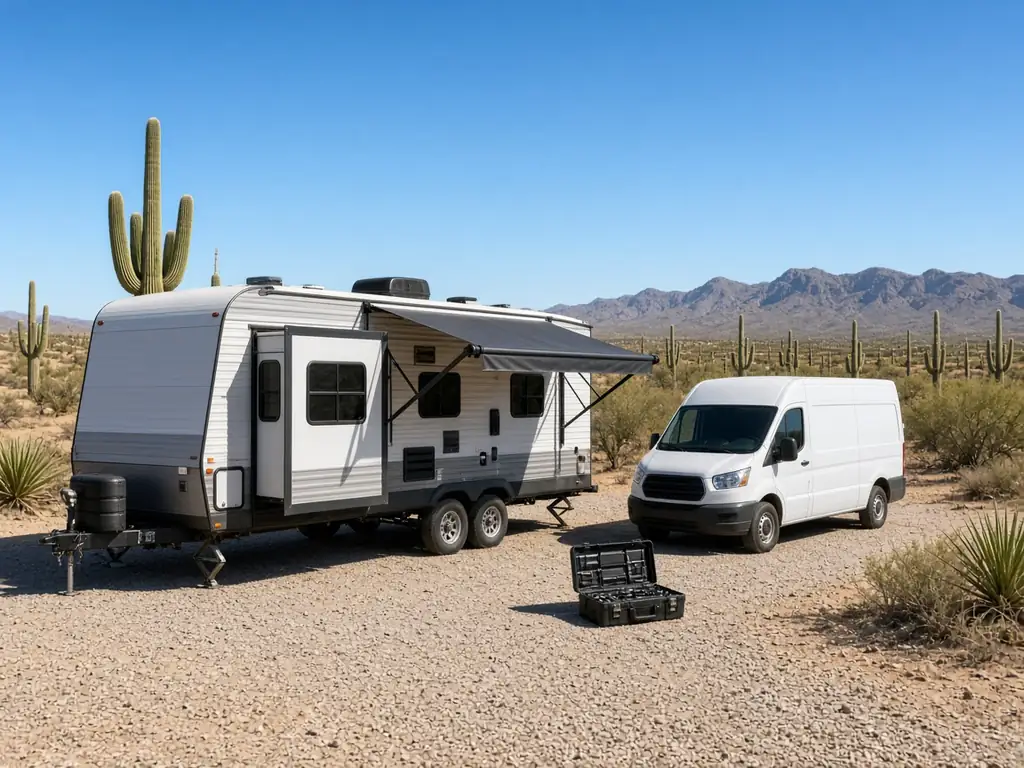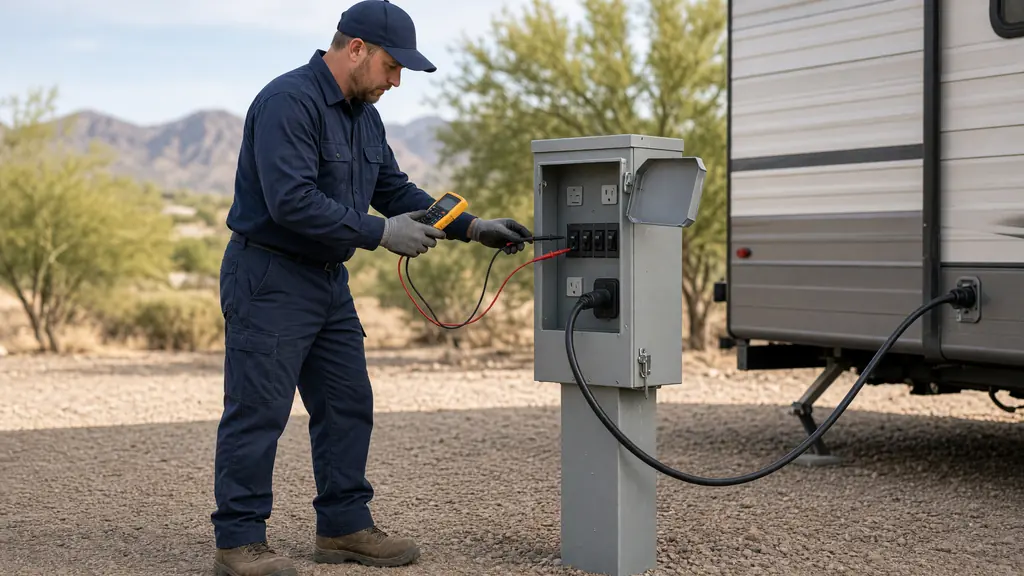
Most RV electrical problems in Tucson start in one of three places: the shore power coming in, the converter that charges the house batteries, or the batteries themselves. Desert heat makes each one worse. When lights dim, outlets go dead or breakers trip, start with the checks below, then call our mobile RV repair in Tucson to trace the fault at the RV.
Key takeaways
- 30-amp service supplies up to 3,600 watts; 50-amp supplies up to 12,000 watts on two 120-volt legs (Camping World).
- A healthy Progressive Dynamics converter reads about 13.6 volts in normal mode.
- A full 12-volt lead-acid battery rests at about 12.73 volts; half charge is about 12.10 volts (Trojan).
- Trojan says battery life drops by half for every 18°F above 77°F.
- The RV's breakers do not protect against bad park power; a surge protector does (Camping World).
What are the most common RV electrical problems?
The common ones are a tripping pedestal breaker, 120-volt outlets that go dead, 12-volt lights that dim or flicker, batteries that will not hold a charge, and a converter that stops charging. An RV runs two systems. The 12-volt side powers lights, the water pump, slide and awning motors, and appliance controls. The 120-volt side runs the air conditioner, microwave and outlets from shore power or the generator. A fault on one side can look like a fault on the other, which is why testing comes before parts.
| Symptom | Where it usually starts |
|---|---|
| Breaker trips when the air conditioner starts | Too much load for the service, or low park voltage |
| 120-volt outlets dead, 12-volt lights fine | A tripped breaker or GFCI outlet, or the shore cord |
| 12-volt lights dim or flicker | A low battery, a loose connection, or no converter charge |
| Batteries dead by morning | The converter is not charging, something draws power, or the battery is worn |
| Slide or awning runs slow | Low battery voltage at the motor |
Why does my RV keep tripping the breaker in Tucson?
Usually because the RV is asking for more power than its service supplies. Camping World's guide says 30-amp service supplies up to 3,600 watts, and 50-amp service up to 12,000 watts across two separate 120-volt legs. On a 30-amp rig, a rooftop air conditioner plus a microwave or an electric water heater element can pass that limit. In Tucson summer heat the air conditioner runs most of the afternoon, so there is little room left for anything else.
- Run one heating appliance at a time: microwave, electric water heater, hair dryer or coffee maker.
- On a 50-amp coach, spread loads across both legs. Camping World notes each leg tops out at 50 amps, about 6,000 watts, and both sides trip together.
- If breakers trip with little running, have the pedestal, cord and wiring tested.
If the air conditioner itself is the problem, read the RV air conditioner repair guide.
How do I check my RV converter and batteries?
Check the batteries at rest with a voltmeter, then have the converter output tested. Trojan Battery says a battery should sit idle with no charging or loads for at least 6 hours, preferably 24, before a voltage reading means anything. Its table puts a full 12-volt lead-acid battery at about 12.73 volts and half charge at about 12.10 volts, and it says to charge any battery reading 70% or less. For the converter, Progressive Dynamics says its PD9100 and PD9200 units should read 13.6 volts, plus or minus 0.3, when tested on shore power.
| State of charge | 12-volt battery at rest |
|---|---|
| 100% | 12.73 volts |
| 90% | 12.62 volts |
| 80% | 12.50 volts |
| 70% | 12.37 volts |
| 50% | 12.10 volts |
Source: Trojan Battery open-circuit voltage table. If the converter reads correctly but the batteries still do not charge, Progressive Dynamics says to check the fuse or breaker in the battery lead next. A converter that reads zero volts often has blown reverse-polarity fuses, which only happens when battery leads were connected backwards.
How does Tucson heat affect RV batteries?
Heat shortens battery life and speeds up self-discharge. Trojan Battery says that for every 18°F rise above 77°F, battery life decreases by 50%, and that temperatures above 80°F speed self-discharge. The National Weather Service puts Tucson's June average high at 101.2°F, more than 20°F above Trojan's reference point. Flooded batteries also lose water as they charge, so Trojan recommends checking water levels once a month until you learn how fast yours use it.
- Add distilled water only, after a full charge. Trojan warns against water with a high mineral content, and Tucson Water describes its water as hard.
- Charge fully after each trip. Trojan says sitting partly charged cuts capacity and life.
- In storage, recharge every 3 to 6 months. Trojan says lead-acid batteries self-discharge 5% to 15% a month, depending on temperature.
- If your converter has a storage mode, use it. Progressive Dynamics' Charge Wizard drops to 13.2 volts to limit gassing and water loss.
Do I need a surge protector for shore power in Tucson?
Yes. It is the only part of the setup that guards the RV against bad power from the pedestal. Camping World's guide explains that the RV's own circuit breakers only protect against overloads inside the coach. They do nothing about high or low voltage, frequency problems, or an accidental 240-volt connection at the post. A surge protector plugs in at the pedestal and takes the hit first, protecting the power cord and the circuits inside. Low voltage at a pedestal can also look like a failing appliance until power is tested.
How much does RV electrical repair cost in Tucson?
Camping World's mobile RV repair cost guide says electrical repairs range from being included in the base labor charge to $2,500 or more for larger jobs. Diagnosis can take longer on electrical problems, because the technician traces the fault through the RV's wiring. Many common faults are quick to fix once they are found. A converter or battery replacement costs more because of the parts. Your trip fee and labor rate are confirmed on the phone, and the repair price before any work starts.
Tucson RV Electrical FAQ
Why does my RV breaker keep tripping in Tucson?
Usually too much load for the service. Camping World says 30-amp service supplies up to 3,600 watts, and an air conditioner plus a microwave or electric water heater can pass it. If it trips with little running, have the pedestal and wiring tested.
Why are my RV batteries dying in the Tucson heat?
Heat speeds self-discharge and shortens life. Trojan Battery says battery life drops by half for every 18°F above 77°F. A converter that is not charging is the other common cause.
Can you test my RV converter at a Tucson RV park?
Yes, when the park allows on-site repair. A technician checks the converter output, the battery voltage and the shore power at the pedestal, then confirms the repair price before any work starts.
Do I need a surge protector at Tucson RV parks?
Yes. The RV's breakers only stop overloads inside the coach. A surge protector guards against bad voltage and miswired pedestals, according to Camping World.
Sources (accessed November 26, 2026): Camping World: 30 amp vs 50 amp · Camping World: Choosing an RV surge protector · Progressive Dynamics: PD9100/PD9200 converter troubleshooting · Progressive Dynamics: Charge Wizard · Trojan Battery: Battery maintenance · NWS Tucson normals and records · Tucson Water: Hard water · Camping World: Mobile RV repair cost guide