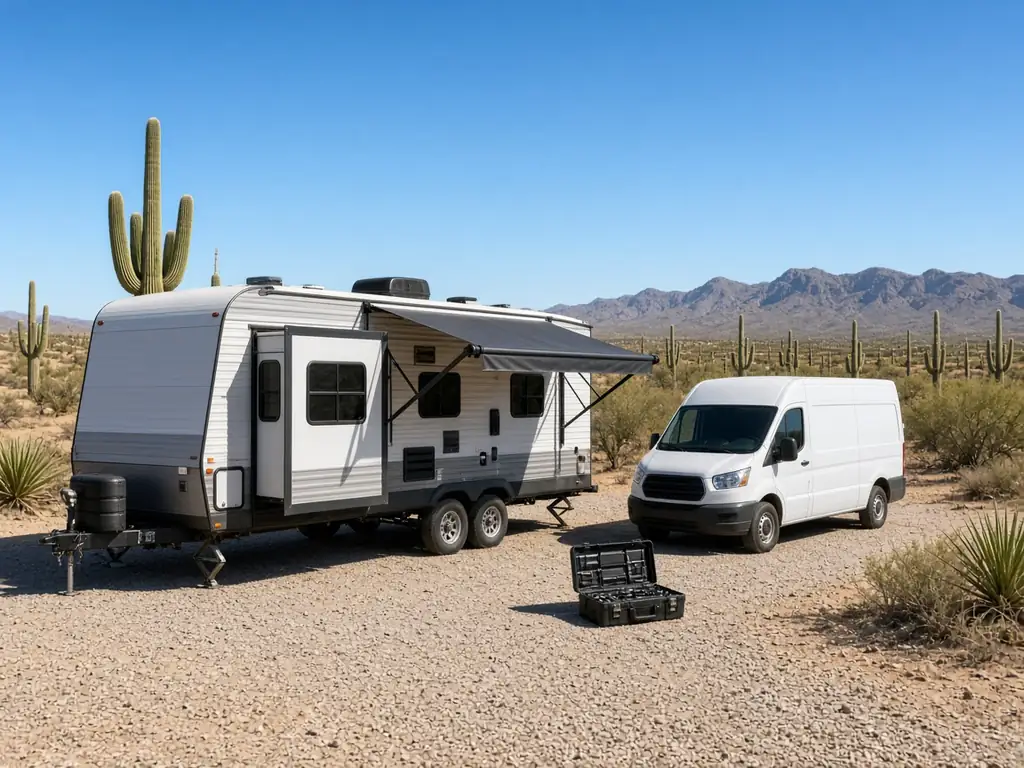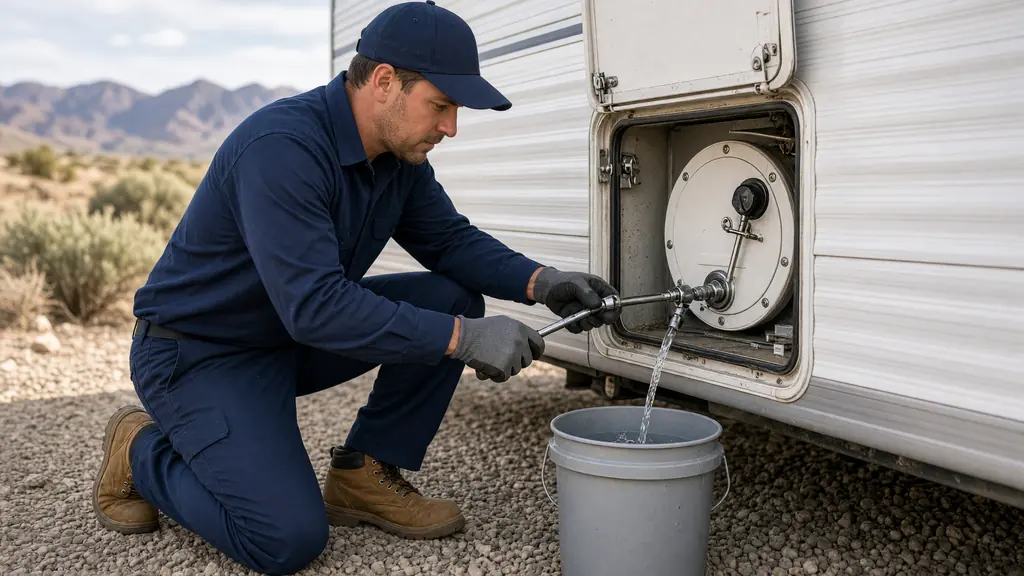
Most RV water heaters in Tucson stop working for ordinary reasons: no propane or power reaching the burner or element, a tripped safety switch, mineral scale from hard water, or a worn anode rod. Tucson Water says the water it serves tends to be hard, and hard water leaves calcium deposits in water heaters. When the checks below do not fix it, our mobile RV repair in Tucson tests the water heater where the RV is parked.
Key takeaways
- Tucson Water serves hard water, which builds calcium in water heaters; it recommends flushing them regularly.
- Suburban says check its anode rod every 6 to 12 months and replace it when more than 75% is gone.
- A dripping relief valve is often normal heat expansion, per Suburban.
- Never run the heater with an empty tank; it can damage the element or trip the cutoff (Suburban).
- Camping World puts water heater repairs at about $100 to $1,000 or more nationally.
Why does my RV water heater stop working?
An RV water heater usually stops making hot water because fuel or power is not reaching it, a safety control has tripped, or the tank itself has a problem. On propane, that means an empty tank, a closed valve or a failed igniter. On electric, it means a breaker, the switch or the heating element. Camping World's troubleshooting guide also names the energy cut-off (ECO) switch, a combined thermostat and high-limit control that shuts the heater down if the tank overheats. If it trips, the cause needs to be found, not just reset.
- No hot water on propane while electric works, or the reverse.
- The burner clicks but will not light, or lights and goes out.
- Hot water runs out fast or never gets hot.
- Water drips from the relief valve at the outside access door.
- A rotten-egg smell from the hot water.
- Water under the heater or inside the compartment.
How does Tucson's hard water affect an RV water heater?
Hard water leaves mineral scale inside the tank, and scale slows heating and shortens tank life. Tucson Water says its groundwater is naturally hard, and hardness rises as more Central Arizona Project water is blended in. Its hard water page says the minerals cause calcium deposits in water heaters, and its tips include flushing the water heater regularly. An RV that fills from a Tucson Water connection gets the same water. Flushing the tank whenever you drain it keeps scale from building up between trips.
| Task | How often | Source |
|---|---|---|
| Check the anode rod (Suburban tanks) | Every 6 to 12 months | Suburban |
| Replace the anode rod | Annually, or when more than 75% is consumed | Suburban |
| Flush the tank | Regularly; hard water builds calcium | Tucson Water |
| Drain the tank | Whenever the RV will sit unused | Suburban |
How often should I check an RV water heater anode rod?
Suburban says to check the anode rod in its water heaters every 6 to 12 months and replace it when more than 75% of the rod is consumed. Elsewhere in the same FAQ it recommends replacing the rod annually or at that 75% point. The anode is a magnesium or aluminum rod that corrodes so the steel tank does not. Suburban notes that only its water heaters use one, so Atwood and Dometic tank heaters do not have one. Water high in iron or sulfate wears the rod faster, and draining the tank between trips extends its life.
Why is water dripping from my RV water heater relief valve?
A small drip from the pressure and temperature relief valve is usually heat expansion, not a failed valve. Suburban explains that water expands as it heats, and an RV water system is closed, so the valve releases the extra pressure. An air pocket at the top of the tank normally absorbs it, and everyday use slowly shrinks that pocket. Restoring the air pocket usually stops the drip. A steady stream, or a drip that keeps coming back after these steps, needs a technician.
- Turn off the water heater.
- Turn off the cold water supply.
- Open a hot faucet inside the RV.
- Pull the relief valve handle and let water flow until it stops.
- Let the handle snap closed, close the faucet, and turn the water back on.
Suburban says to repeat this as often as needed. If the weeping persists, its next step is an expansion or accumulator tank in the cold water line.
What should I check before calling about my RV water heater?
Check fuel, power and the water supply first, then look for leaks. Confirm the propane tank has gas and its valve is open, the water heater switch is on, and the electric breaker has not tripped. Make sure the bypass valve is set to normal so the tank is full. Suburban warns that running the heater with no water in the tank can melt the insulation jacket, trip the cutoff, or damage the electric element.
- Propane: the tank has gas, the valve is open, and other propane appliances light. If the refrigerator's propane side also fails, read the RV refrigerator guide.
- Electric: the water heater switch is on, the breaker is not tripped, and shore power or the generator is on.
- Water: the bypass valve is in its normal position and the tank is full.
- Hot tank, cold refill: Camping World warns that refilling a hot, empty tank with cold water can crack the lining. Wait 60 to 120 minutes for it to cool.
- Smell: a rotten-egg odor is usually sulfur bacteria. Suburban suggests about 6 ounces of household bleach per 10 gallons in the fresh water tank, run to every faucet, left a few days, then flushed out.
How much does RV water heater repair cost in Tucson?
Camping World's mobile RV repair cost guide puts water heater repairs at about $100 to $1,000 or more nationally. Small parts are inexpensive: a thermostat about $40 to $80, a heating element about $30 to $60, and an anode rod around $12. Labor for a basic tank swap typically runs $200 to $400. The top of the range is a full replacement or a tankless upgrade that needs gas-line work. Your trip fee and labor rate are confirmed on the phone, and the repair price before any work starts.
Tucson RV Water Heater FAQ
Why is my RV water heater not working in Tucson?
Usually no propane or power is reaching it, a safety cutoff has tripped, or the tank is empty. Check the propane valve, the heater switch, the breaker and the bypass valve first. If those are fine, the heater needs testing at the RV.
How often should I replace my RV water heater anode rod in Tucson?
Suburban says to check it every 6 to 12 months and replace it when more than 75% is consumed, or annually. Atwood and Dometic tank heaters do not use an anode rod.
Does Tucson's hard water damage RV water heaters?
It builds calcium deposits, according to Tucson Water, which recommends flushing water heaters regularly. Flush the tank whenever you drain it.
How much does RV water heater repair cost in Tucson?
Camping World's national range is about $100 to $1,000 or more, with small parts like a thermostat or element under $100. Your repair price is confirmed before work starts.
Sources (accessed November 26, 2026): Suburban (Airxcel) FAQs · Tucson Water: Hard water · Tucson Water: Water quality FAQ · Camping World: RV water heater not working · Camping World: Mobile RV repair cost guide