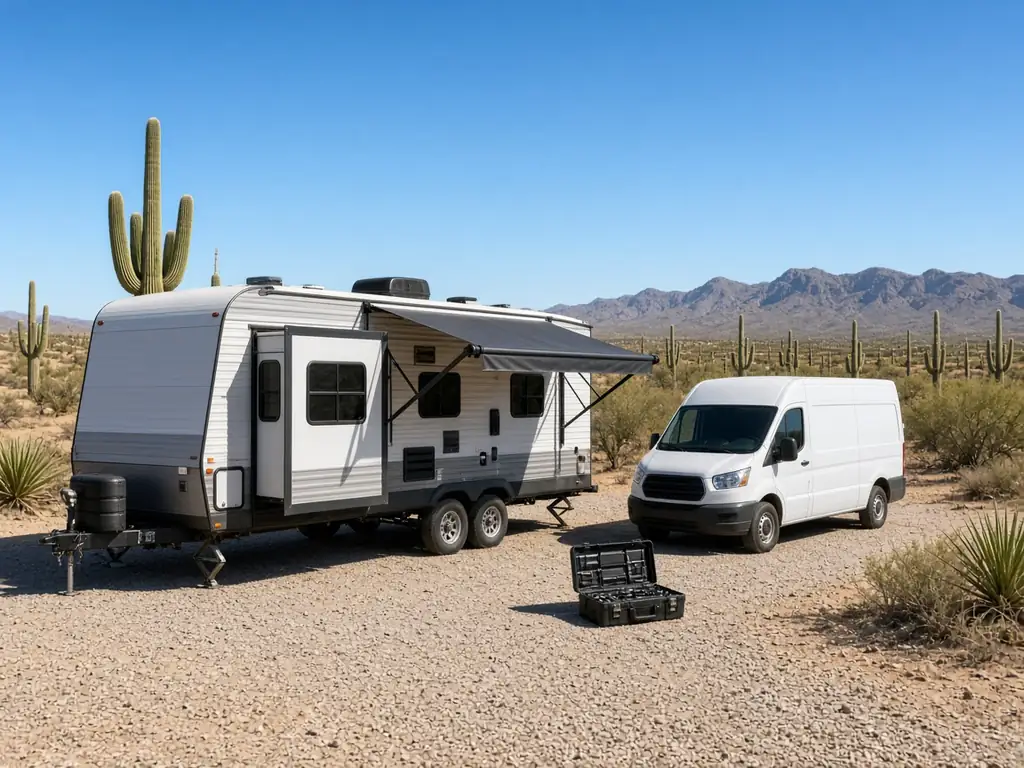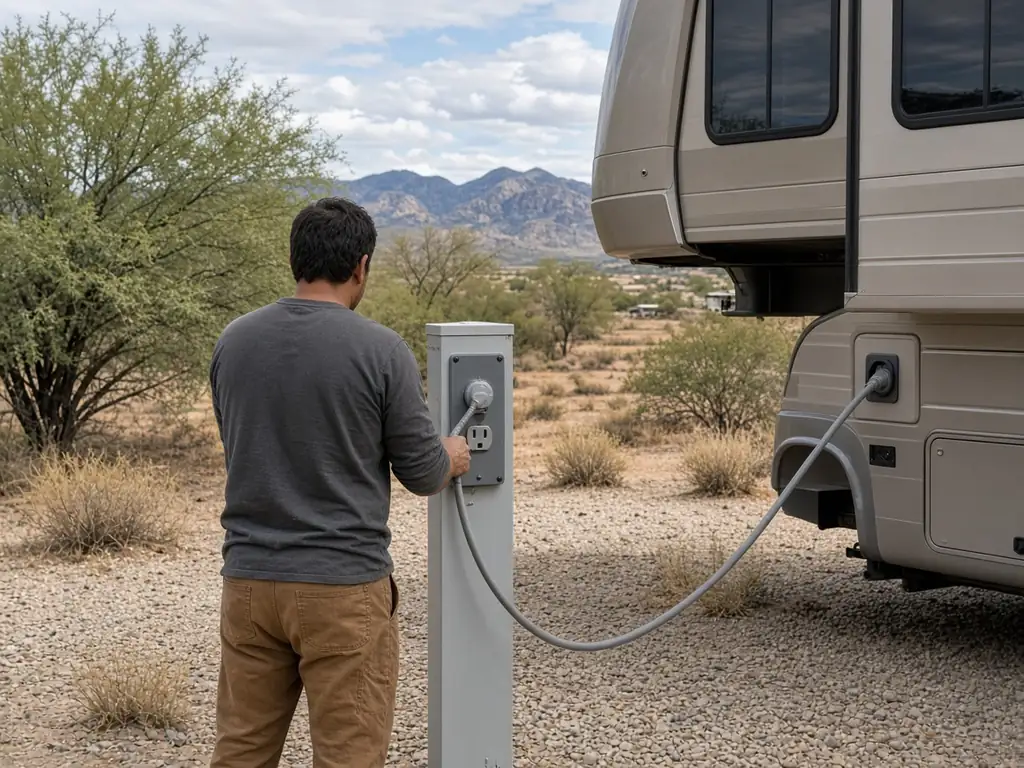
Start with a walk-around and the batteries, then check the systems in the order you will use them: tires and running gear, roof, water, generator, air conditioner and furnace. A Tucson summer averages 68 days at or above 100°F (National Weather Service, 1991 to 2020 normals), and heat plus months of sitting show up first in batteries, sealant, fuel and tires. If a check turns up a problem, our mobile RV repair in Tucson comes to the RV at home, in a park or in a storage lot.
Key takeaways
- Lead-acid batteries lose 5% to 15% of their charge a month in storage (a battery maker's guide).
- Read the tire date code: its last four digits give the week and year made (49 CFR 574.5).
- Run the generator under load before you need it; gasoline can go bad in as little as 30 days (a generator maker).
- Inspect all sealants at least every six months (one major RV maker's owner's manual).
- Do not sweep or vacuum pack rat droppings; wet them with disinfectant first (CDC).
What should I check first when I take my RV out of storage?
Walk around the RV before you plug in or start anything, looking for nests, leaks and tires that have lost air. Look in the compartments and the generator bay for sticks, cactus pieces and other debris, the kind of material University of Arizona Extension describes in pack rat nests. Check the furnace and water heater vents, because a major RV furnace maker lists wasp nests and tape among the things that block a vent. Look at the ceiling and walls for stains, and at the roof for cracked sealant. Then check the batteries, since almost every other system needs 12-volt power.
| Order | System | First check |
|---|---|---|
| 1 | Walk-around | Nests, droppings, stains, leaks and tire pressure |
| 2 | Batteries | Full charge, a rest, then a voltage reading; water level on flooded batteries |
| 3 | Tires and running gear | Date code, pressure and sidewalls; bearings and brakes before a trip |
| 4 | Roof and seals | Cracked, peeling or gapped sealant on the roof and around windows |
| 5 | Water system | Filter, a flush, leaks, and a full water heater before it is turned on |
| 6 | Generator | Start it and run it under load |
| 7 | Air conditioner | Temperature drop between the return air and the first vent |
| 8 | Furnace | Clear vent, clean blower, and a test before the first cold night |
Each check is explained in the sections below.
How do I bring RV batteries back after summer storage?
Charge them fully, let them rest, then test the voltage before you rely on them. A battery maker's maintenance guide says lead-acid batteries self-discharge 5% to 15% a month depending on temperature, and that heat above 80°F speeds it up, so a battery left uncharged all summer can be flat. The same guide says to let a battery rest at least 6 hours, preferably 24, before a voltage reading, and to top up flooded batteries with distilled water only. A battery that will not come back after a full charge may need replacing. See RV battery replacement in Tucson and RV electrical problems for the voltage table.
Are my RV tires safe after a summer parked in the sun?
Check their age, pressure and sidewalls before the first drive. Federal rules require a date code on every tire, and its last four digits give the week and year it was made (49 CFR 574.5). A published RV tire guide says to check pressure before every trip, because temperature and elevation change it, and that tire covers slow dry rot and sun damage on a parked rig. One major trailer axle maker's schedule lists a weekly look for cuts, wear and bulges, and an inspection and repack of the wheel bearings every 12 months or 12,000 miles. See RV wheel bearing and brake service.
Will my RV generator start after sitting all summer?
It may not, so start it and run it under load before you need it. A major RV generator maker's operator manual says to exercise the generator at least two hours a month at about half its rated load, and to do storage prep if it will sit more than 120 days. The same maker notes that gasoline can go bad in as little as 30 days. A summer in storage runs past both limits. If the generator will not start, surges, or shuts off when the air conditioner starts, see RV generator repair in Tucson.
What roof and seal checks matter after a Tucson summer?
Look for cracked, peeling or gapped sealant on the roof and around every window, vent and seam. One major RV maker's owner's manual says to inspect all sealants at least every six months, to have sealant replaced if it shows cracks, peeling, voids, gaps or looseness, and to reseal at least once a year. It names ultraviolet exposure as one cause of sealant damage. After a summer of 100°F days and a monsoon season that runs June 15 to September 30, a stain on the ceiling or below a window is worth tracing now. See RV roof and leak repair and RV window leak repair.
How do I restart the RV water system after storage?
Replace or check the filter, flush the lines, and fill the water heater before you turn it on. One major RV maker's owner's manual says to replace water filters at the beginning of each season and to let water run for several minutes to flush a system that has not been used for some time. A major RV water heater maker's FAQ warns that running the heater with no water in the tank can melt the insulation jacket, trip the cutoff and damage the element. With every faucet closed, the pump should stop once the lines are pressurized; a published RV water pump guide says a pump that keeps running points to a leak. See RV plumbing leak repair.
Should I test the AC and furnace before I need them?
Yes, test both, because each one sat unused for months. For the air conditioner, an RV air conditioner maker's FAQ says a healthy unit cools the air 16 to 22°F below the return air, and to clean the outdoor coil at least once a year. For the furnace, a major RV furnace maker's service manual says dust and lint on the blower wheel or sail switch can keep it from lighting, and that a furnace left unused can need cleaning more than one used often. Tucson's average low drops to 40.5°F in December, per National Weather Service normals. See RV furnace repair and RV AC repair.
What does pack rat damage look like in a stored RV?
Look for a nest of sticks, cactus pieces and debris, droppings, and chewed wire insulation in the compartments. University of Arizona Extension says pack rats occasionally damage vehicles and wiring, and the CDC says rodents may build nests in cars, trucks and campers. Do not sweep or vacuum droppings or nest material: the CDC says to spray them with a bleach solution or disinfectant until very wet and let it soak first. If lights, slides or appliances stopped working over the summer, have the wiring tested before you rely on the RV. See pack rat damage to RV wiring.
Tucson RV Start-Up FAQ
How long can an RV battery sit in Tucson storage?
Not all summer without a charge. A battery maker's maintenance guide says lead-acid batteries self-discharge 5% to 15% a month, faster in heat, and should be recharged every 3 to 6 months in storage.
When should winter visitors book a start-up check in Tucson?
Soon after you arrive, before you need heat. National Weather Service normals put Tucson's average low at 47.9°F in November and 40.5°F in December.
Can you do the start-up check at my storage lot?
Yes, as long as the storage facility allows repair work on site. Name the lot, and give any gate code and space number when you call.
Do you check propane lines during a start-up check?
No. Propane lines, tanks and regulators are not on our service list. If you smell propane, turn off the tank valve, leave the RV and call 911 or your propane supplier from a safe distance.
Sources (accessed November 27, 2026): NWS Tucson normals · 49 CFR 574.5 (tire date code) · CDC: How to clean up after rodents · University of Arizona Extension: Pack rats (2023) · a battery maker's maintenance guide · a major RV generator maker's operator manual · one major RV maker's owner's manual (2024) · an RV air conditioner maker's FAQ · an RV furnace maker's service manual · one major RV water heater maker's FAQ · a published RV tire guide · a published RV water pump guide · a trailer axle maker's maintenance schedule (2026)